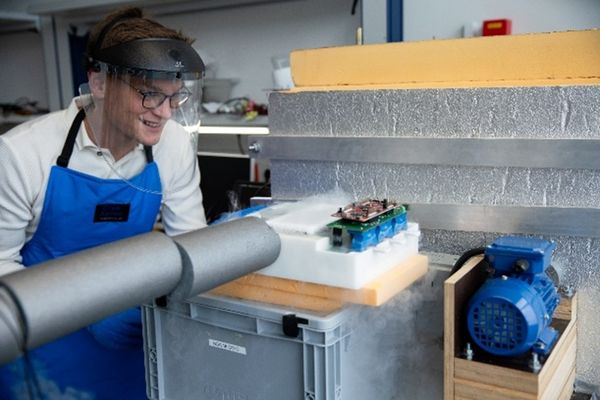
Cryogenic Power Electronics
At cryogenic temperatures, power losses in power semiconductors and conductor materials are significantly reduced. This is due in particular to the increased charge carrier mobility in semiconductors and the greatly reduced specific electrical resistance of metallic conductors. This enables a substantial increase in efficiency as well as gravimetric and volumetric power density of power electronic converters.
In the context of electrified aviation, liquid hydrogen (LH₂) with a temperature of around 20 K (−253 °C) is considered a promising energy carrier. Before it can be used in fuel cell systems, it must be vaporised and thermally conditioned. The temperature difference available in this process represents an inherent cooling resource that can be used to cool power electronic components. Cryogenic power electronics thus enable the functional coupling of hydrogen conditioning and electrical energy conversion while simultaneously increasing system efficiency and power density.

The design of cryogenic power converters requires the targeted selection, characterisation and modelling of semiconductors, passive components, insulation systems and connection technologies under low-temperature conditions. In addition, thermo-mechanical stresses resulting from strong temperature gradients have a significant impact on reliability and service life. A holistic system design must therefore take electrical, thermal and mechanical aspects into account equally.
Our research addresses these challenges through the systematic investigation of cryogenic power electronics from the component to the overall system. The aim is to develop efficient, reliable and highly integrated power converters for future hydrogen-based energy systems, particularly in aviation.
- Aerospace
- Liquid Hydrogen( LH2) and Liquefied Natural Gas (LNG) infrastructure in energy technology
- the systematic investigation of cryogenic power electronics from components to complete systems
- the development of efficient, reliable and highly integrated power converters for future hydrogen-based energy systems
- Low-temperature cycling test facility
- cryogenic Zth measurement station
- various cryogenic temperature measurement chambers
- cryogenic measurement station for characterising soft magnetic materials
- cryogenic double pulse measurement station
Research Projects