Energy-Efficient Degradation Mechanisms, Diagnostic Procedures, and System Architectures for Batteries
The research field of energy-efficient degradation mechanisms, diagnostic procedures, and system architectures for batteries comprises the following areas of research:
- Analysis of battery degradation mechanisms
- Energy management algorithms and diagnostic procedures
- Energy-efficient and safe battery system architectures

Research focuses on analyzing battery aging, optimizing operation and safety, and the holistic design of battery systems.
The aim is to develop powerful, safe, and long-lasting batteries by understanding degradation mechanisms, intelligent control and diagnostic techniques, and innovative system concepts. Energy management, condition monitoring, mechanical and thermal design, electrical integration, and modular and sustainable designs are all taken into account. Extensive testing and simulation capabilities support the development of efficient solutions for applications ranging from consumer level to stationary and mobile systems, such as in electromobility or for grid flexibility.
- Analysis of chemical, physical, and electrochemical aging mechanisms
- Lifetime and degradation modeling
- Aging diagnostics and prognosis methods (state estimation & remaining useful life)
- Experimental validation at cell and module level
- Energy management strategies for charging and discharging processes
- Model-based state determination (SoC, SoH, SoP)
- Data-driven methods and machine learning for diagnosis and prognosis
- Safety strategies and fault detection
- Holistic system design from cells to overall system
- Thermal, mechanical, and electrical design
- Integration into mobile and stationary applications
- Modular architecture, scalability, and sustainability
- Simulation-based development and optimization
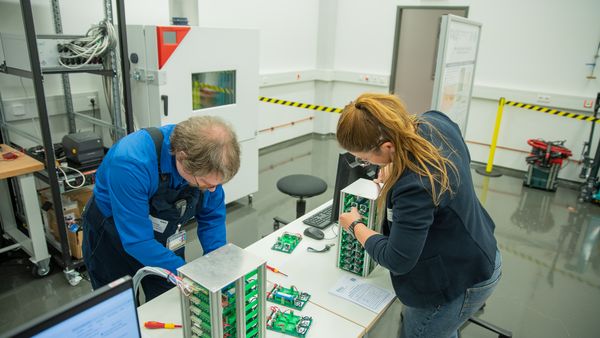
- Cyclic testing and impedance spectroscopy for systematic characterization and aging testing, including large-format battery cells, as well as the necessary temperature chambers and ovens
- Energy management system real-world laboratory with generators and consumers, controllable loads and sources, and rapid prototyping toolchain
- Abuse test center for destructive testing at cell and module level, including variable trigger devices and high-precision measurement technology
- Vermessung von Batteriezellen sowie deren Modellierung
- Auslegung von Batteriesystemen für die Anwendung
- Zerstörerische Prüfung von Batterien
- Optimierung Energieversorgung für u.a. Industriestandorte
Research Projects