Vanadium-Redox-Flow-Batteries
Prof. Dr. Roswitha Zeis' research group is working in this field on Vanadium-Redox-Flow-Batteries (VRFB). Vanadium-Redox-Batteries are a promising technology for stationary energy storage, as they are highly efficient and significantly more durable than conventional batteries.
As part of our research, we are investigating new electrode materials using a multimodal characterization approach. The research group's expertise lies in the areas of electrochemical characterization and X-ray-based imaging with synchrotron radiation.

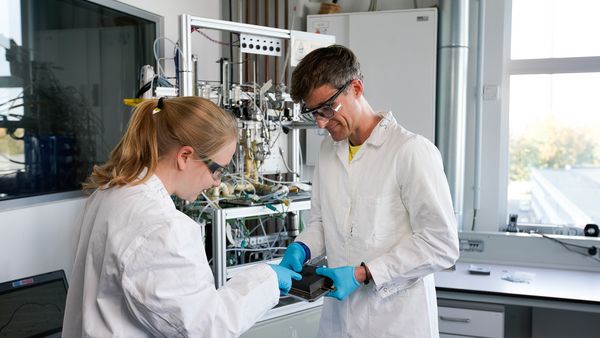
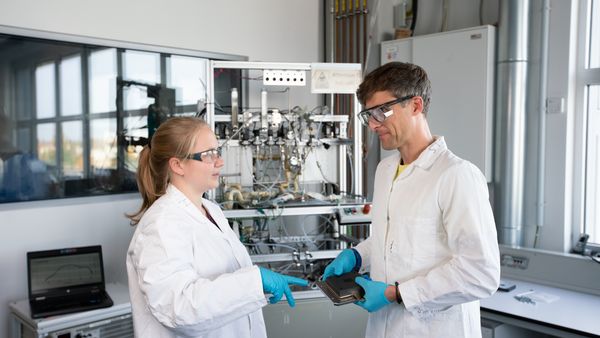
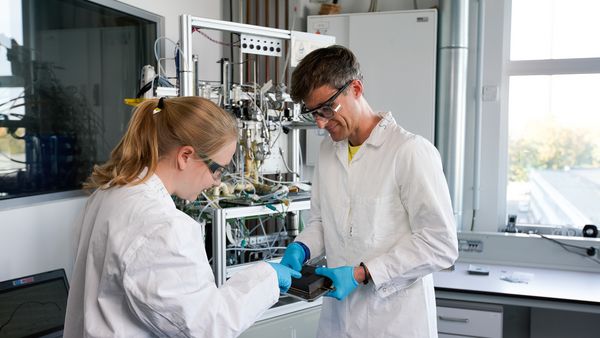
- use in stationary energy storage
- Evaluation of the performance of vanadium redox flow half-cells using electrochemical impedance spectroscopy (EIS)
- Test bench: parallel operation of 2 cells (active area 4 cm²) as fuel cells or pumps at temperatures up to 200 °C
- Potentiostats for the electrochemical characterization of (half) cells, e.g., electrochemical impedance spectroscopy (EIS), cyclic voltammetry (CV)
- Equipment for the production of gas diffusion electrodes (max. 25 cm²)
- Rotating disk electrode (RDE) for the fundamental electrochemical characterization of catalysts
- Gas chromatograph for analyzing the purity of hydrogen
- Full and half cells for characterizing electrodes for VRFB, including measurement of pressure losses in the electrode
- Evaluation of cells and cell components
- Manufacture of membrane electrode assemblies and gas diffusion electrodes