Electric Drive Systems
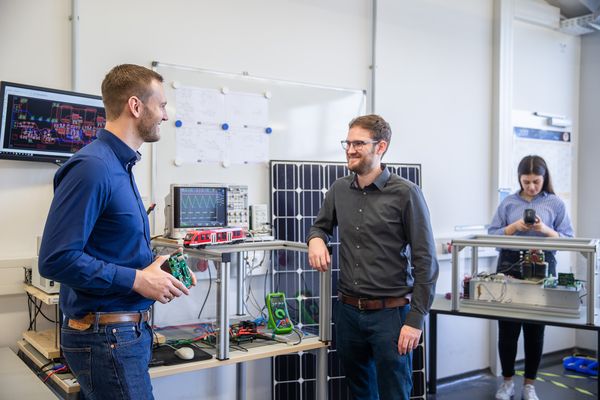
The Institute for Power Electronic Systems (ELSYS) at Nuremberg Tech is engaged in research on electrical drive systems. It focuses on the development and optimization of modern electrical drive systems, with a particular emphasis on power electronics, control methods, and efficient operating strategies. The goal of the research is to improve the efficiency, power density, and functionality of electric drives through new converter concepts, advanced modulation and control approaches, and a systematic analysis of inverters and electric machines. Both classical model-based methods and novel approaches, such as those from the field of artificial intelligence, are investigated. The research thus combines power electronics, drive technology, and control engineering and addresses current challenges in modern electric drive systems.
The developed concepts are particularly relevant for applications in electromobility, industrial automation, robotics, and other areas where efficient and highly dynamic electric drives are required.


Highly dynamic and efficient electric drives, e.g., in:
- the automotive industry
- industrial automation
- and robotics
- Power electronics for drive inverters: Use of various topologies (2L, 3L, resonant, multilevel) and semiconductor technologies (SiC, GaN, hybrid)
- Efficient inverter operating strategies (variable PWM, modulation methods, overmodulation)
- Efficient motor operating strategies (various motor types, MTPx)
- Application-specific functions:
-Harmonic current injection for noise optimization
-Sensorless control
-use of various current sensor topologies (single shunt, DC shunt, etc.) - Novel control methods:
-Model predictive control
-AI control methods (e.g., using reinforcement learning)
- Engine test benches up to 400 kW (speed range up to 40,000 rpm, torque range up to 5,000 Nm)
- Precise power measurement of multiphase systems
- Laser vibrometers for vibration analysis
- Development and optimization of electric drive systems (inverters, motors, control systems)
- Design and evaluation of inverter topologies, as well as selection of suitable power semiconductor technologies (e.g., SiC, GaN)
- Measurements and characterization of electric machines (e.g., characteristic mapping, loss analysis, efficiency determination)
- Experimental investigation and efficiency analysis of inverter-motor systems on motor test benches (from the low-power range up to 400 kW)
- Validation and optimization of modulation and control methods for electric drives
- Acoustic and vibration analyses of electric drives (e.g., for noise reduction or NVH optimization) using vibroacoustic measurement techniques
- Hardware-based validation of new control and regulation methods on real test benches
- Support for prototyping and proof of concept for new drive concepts or control strategies
- Joint research and development projects as well as feasibility studies for new electric drive technologies
- Technical consulting and training in the fields of power electronics, electric drives, and control engineering
Related Research Projects
KI-Power