BMWK Project EOS
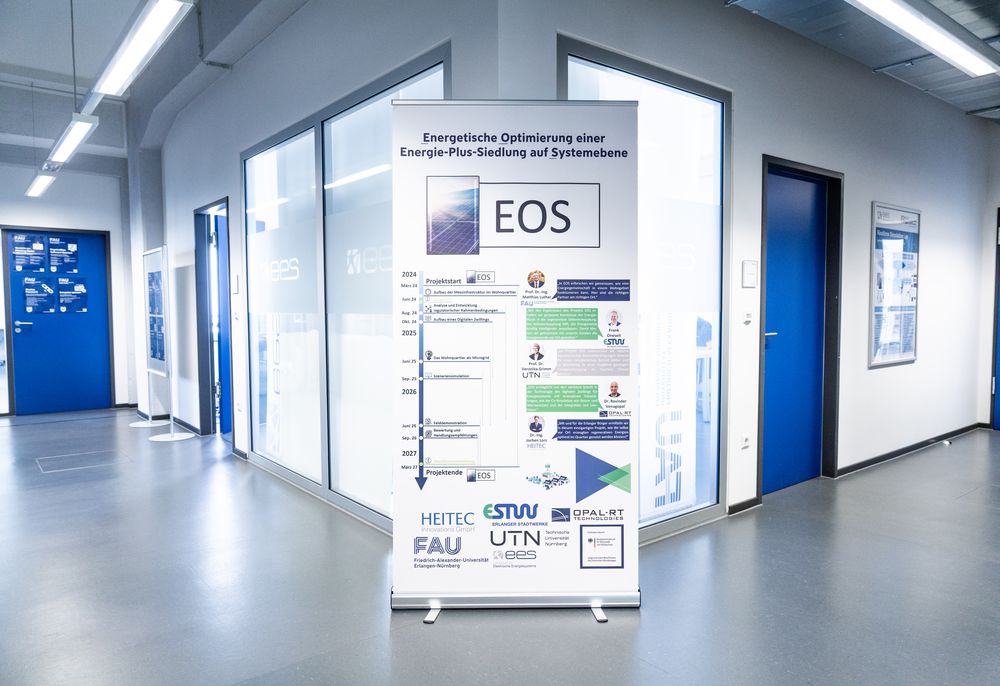
The local EOS project in the Erlangen-Nuremberg area is being carried out in collaboration with residents of Development Area 411 in Erlangen and regional project partners including Erlanger Stadtwerke AG, Heitec Innovations GmbH, Opal RT Germany, the Technical University of Nuremberg, and the Chair of Electrical Energy Systems at Friedrich-Alexander University, which is leading the project. EOS pursues an approach of optimized energy use—including electricity, heating, cooling, and mobility—at the neighborhood level to create an energy community.
In this context, a network of residential units is systematically optimized beyond the boundaries of individual household connections. Possible optimization goals include increasing the feed-in from existing PV systems and optimizing heat and electricity storage management. This is to be achieved through the coordinated operation of the electricity, heating, and transportation sectors, taking into account generation, consumption, and available storage. The available grid capacities in the residential area are incorporated and utilized as optimally as possible.
In addition, taking into account the regulatory framework, both technical and economic scenarios are analyzed and simulated on the resulting simulation model (“Digital Twin”). Using the resulting simulation model, it is possible to develop optimization algorithms, automation processes, and additional components to be integrated, such as charging stations and centralized and decentralized storage systems.
2024-2027
- Heitec Innovations GmbH
- ESTW
- City Erlangen
- Opal-RT, UTN
Federal Ministry of Economic Affairs and Energy
At the start of the project, the data collection and transmission system to Friedrich-Alexander University will be set up. After a 3-month project period, the number of participants will be reviewed. If the results are deemed insufficiently meaningful due to an insufficient number of participants, the project will not be continued.
While the measurement technology is being installed, the regulatory framework will be analyzed and potential adjustments developed. Additionally, the digital twin of the development area will be implemented on the Friedrich-Alexander University’s real-time simulator. After the simulation model is established and the measurement data integrated, the residential neighborhood will be examined as a microgrid, meaning the various energy flows of the respective households will be analyzed and optimized collectively. Halfway through the project, a wide variety of scenarios will be developed and examined. These may involve the integration of additional components such as storage and charging infrastructure, or various optimization algorithms such as economic incentives, grid services, and island operation capability. Field tests will be conducted in the final year. During these tests, control signals from the developed optimization algorithms will be sent to specific systems within the development area.