
Prof. Dr. Daniel Gerhard
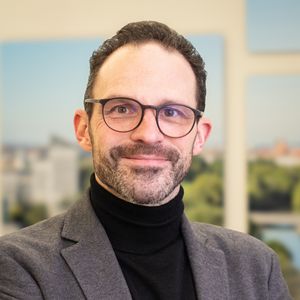
Person
Prof. Dr. Daniel Gerhard studied industrial engineering at Friedrich-Alexander University Erlangen-Nuremberg (FAU), where he earned his Ph.D. in Strategic Technology Management in 2010. After holding various positions in the automotive supply industry, he became a professor of Strategic Management at Georg Simon Ohm University of Applied Sciences in Nuremberg in 2023. His research focuses on technology and innovation management, particularly on the analysis and promotion of technology adoption and technology openness, as well as on behavioral strategy. His work addresses the question of how technological transformation processes can be effectively designed under conditions of uncertainty, thereby contributing to topics related to energy and technology transformation.
2001–2006: Bachelor’s degree in Industrial Engineering, FAU Erlangen-Nuremberg
2006–2010: Ph.D. program in Strategic Technology Management, FAU Erlangen-Nuremberg
2010–2011: Product Development Consultant, 3DSE Management Consultants
2011–2014: Innovation Manager, Schaeffler Technologies
2014–2019: Overall Project Manager for Additive Manufacturing, Schaeffler Technologies
2019–2021: Senior Manager of Strategic Product Planning, Grammer AG
2022–2023: Senior Manager of Group Strategy, Grammer AG
Since 2023: Professor of Strategic Management, Nuremberg Tech (Georg Simon Ohm University of Applied Sciences)
- Technology and Innovation Management with a focus on strategic decision-making under uncertainty
- Technology adoption and diffusion, particularly in the context of energy technologies (e.g., hydrogen)
- Measuring and promoting technology openness and technology acceptance among individuals and organizations
- Behavioral strategy, particularly cognitive biases in technology-related contexts
- Strategic management of new technologies and their integration into existing business models
- Additive manufacturing (3D printing) as an enabler for decentralized and flexible production systems
- Design and evaluation of interventions to accelerate the diffusion of sustainable technologies