Carnot Batteries as Efficient Energy Storage Devices
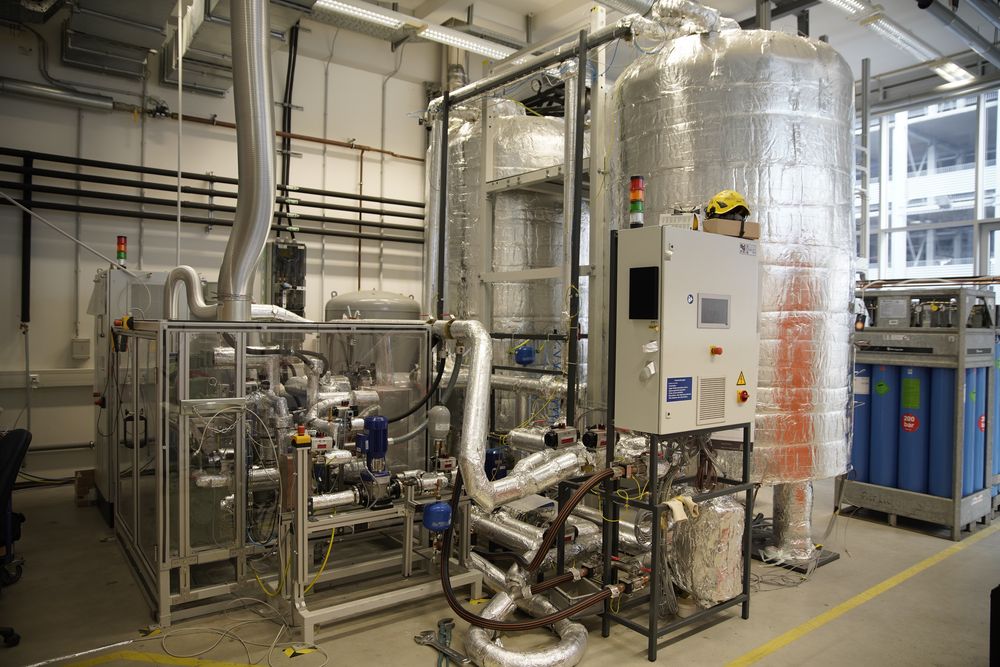
The energy transition requires efficient solutions for storing large amounts of renewable energy and for harnessing previously untapped waste heat potential. Carnot batteries offer a promising approach to this: Low-temperature waste heat is raised to a higher temperature level using a high-temperature heat pump and stored in the form of hot water at temperatures up to 200°C. When needed, the stored thermal energy is converted back into electricity via an Organic Rankine Cycle (ORC). This concept combines the advantages of cost-effective thermal storage with the flexibility of on-demand power generation, thereby contributing to sector coupling and the integration of fluctuating renewable energy sources.
The following research questions are being investigated:
- How can the overall efficiency of a Carnot battery be increased?
- Which sustainable, climate-friendly refrigerants and fluid mixtures are suitable for efficient operation at these temperatures?
- How must control technology and operating strategies be designed to ensure efficient and robust plant operation under real-world conditions?
- What impact do flexible, elevated storage temperatures have on the system’s efficiency, storage capacity, and economic viability?
- How can the findings obtained on a laboratory scale be transferred to larger, industry-scale applications?
The goal of the ongoing work is to further develop Carnot batteries as an efficient and flexible energy storage technology and to improve their cost-effectiveness for practical application. The focus is on increasing process efficiency by optimizing working fluids, system components, and operational management in order to establish Carnot batteries as a building block of a cross-sector, renewable energy supply.


As part of the EnCN Phase 2 funding program, a first-of-its-kind Carnot battery system was installed at the Nuremberg Energy Campus and successfully commissioned. The system consists of a reversible high-temperature heat pump and two hot-water storage tanks, each with a capacity of 4,000 liters. The system achieves an electrical output of up to 15 kW and serves to demonstrate the technical feasibility of the overall concept.
Building on the successful proof of concept, the current research focuses on improving the efficiency of the overall process. This includes, in particular:
the identification and experimental investigation of suitable sustainable refrigerants and fluid mixtures for heat pump and ORC processes,
the optimization of control technology and operating strategies,
the investigation of system operation with flexible storage temperatures to increase storage capacity and process flexibility
Outlook: Based on the ongoing optimization efforts, the insights gained will be incorporated into the design of more powerful and cost-effective Carnot battery systems in the future. The long-term goal is to transfer the technology to industrial applications in order to position Carnot batteries as a building block for flexible, decentralized energy storage solutions.