WINDBreaks
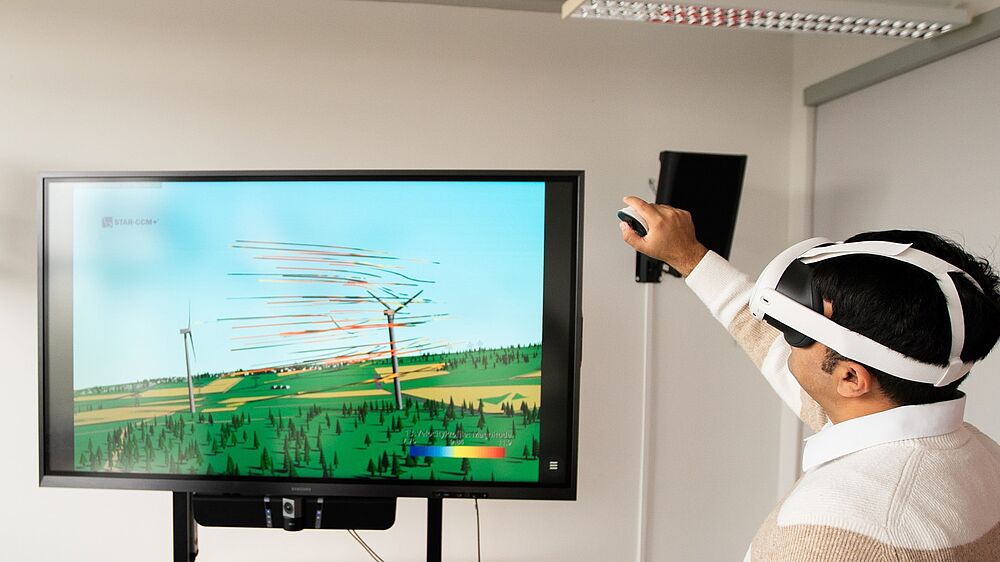
To successfully navigate the energy transition, it is crucial to accelerate the expansion of wind energy in inland areas. The “WINDbreaks” research project aims to contribute to this effort by investigating ways to increase the full-load hours of wind turbines in complex terrain.
The project involves metrological and numerical studies of wind turbines and rows of trees that serve as windbreaks. The flow over the windbreak strips leads to an acceleration of wind speed, which is proportional to the cube of the wind speed in the power output of wind turbines. The flatter speed profile at the height of the rotor blades is an additional side effect that has a positive impact, as it results in a more even distribution of the forces acting on the turbine.
The drone-based wind measurement technology developed by project partner Optulotion is used to generate measurement data for the CFD analyses conducted by Ansbach University of Applied Sciences, while associated project partner N-ERGIE provides the necessary measurement sites.
Ansbach University of Applied Sciences conducts field studies on actual reference wind turbines in complex terrain, utilizing a combination of measurement-based and numerical methods. A numerical model is constructed using the measurement results. By coupling the simulation models, it is possible for the first time to analyze the aerodynamic and structural effects of the windbreak strips on the wind turbine. Through parameter studies, botanical, seasonal, and turbine-specific effects are investigated and incorporated into a yield calculation. Finally, a cost-benefit analysis of large-scale tree transplantation is conducted for both existing and new wind farms.